Guide
How to pay for domains with crypto
To pay for domains with crypto at Zonequill, you fund an account balance in Monero, Bitcoin, USDT, USDC, Ethereum, Solana or Litecoin, then spend it on transfers, renewals and registrations. Each top-up runs from $25 to $10,000. The figure quoted goes to the deposit address on screen; nobody asks for a transaction ID or an identity document.
| Coins accepted | BTC, USDT, USDC, ETH, SOL, LTC, XMR |
|---|---|
| Monero | Yes, received in our own wallet, no third-party processor |
| Payment model | A US dollar balance you fund in crypto before ordering |
| Top-up limits | $25 minimum, $10,000 maximum per top-up; repeat as often as needed |
| What you send | The precise sum quoted, to the deposit address on screen |
| Transaction ID (TXID) | Not asked |
| Identity | No ID document, no phone; a registrant email confirmed within 15 days |
| Balance | No expiry; pays transfers, renewals, registrations |
| Cards, PayPal, bank wires | Not offered |
Which coins and chains does Zonequill accept?
Seven coins: Monero, Bitcoin, Litecoin, ether, USDC, USDT and Solana, with USDT on two chains, Tron and Ethereum. Each confirmation means one more block mined on top of the block carrying your payment. Credit lands when the count in the last column is reached, from 1 block for Solana to 20 for USDT on Tron.
| Ticker | Coin | Chain (token format) | Blocks to wait |
|---|---|---|---|
| XMR | Monero | Monero | 10 |
| BTC | Bitcoin | Bitcoin | 2 |
| LTC | Litecoin | Litecoin | 6 |
| ETH | Ether | Ethereum | 12 |
| USDC | USD Coin | Ethereum (ERC-20) | 12 |
| USDT | Tether | Ethereum (ERC-20) | 12 |
| USDT | Tether | Tron (TRC-20) | 20 |
| SOL | Solana | Solana | 1 |
TRC-20 is Tron's token format and ERC-20 is Ethereum's; Tether mints USDT under both. Addresses on the two chains look different and cannot stand in for each other, so pick the chain named beside the deposit address. More on stablecoins: USDT domain payments. Paying renewals in XMR: Monero domain renewals.
How do you pay for domains with crypto?
In six steps: open Top up, type a dollar figure from $25 to $10,000, choose a coin, send the exact sum shown, press "I've sent the payment", then spend the credited balance on transfers, renewals or registrations. There is no sign-up form and no account email: your first payment creates a 16-digit account number, which becomes your login.
Open the top-up page
Go to Top up under billing and type a dollar figure from $25 to $10,000. A first payment needs no registration; returning customers log in with their 16-digit account number.
Choose a coin
Pick Monero, Bitcoin, USDT (Tron or Ethereum, explained in USDT domain payments), USDC, ether, Solana or Litecoin. On screen you get a deposit address plus the precise figure due in that coin.
Pay that figure
Pay it from a wallet you control, using the chain named beside the address.
Click "I've sent the payment"
This alerts the desk, which then looks for the transfer. No TXID, no screenshot.
Wait for the blocks
Credit appears once the block count from the table is reached. Monero is matched by a person on the desk, so it takes longer.
Spend the balance
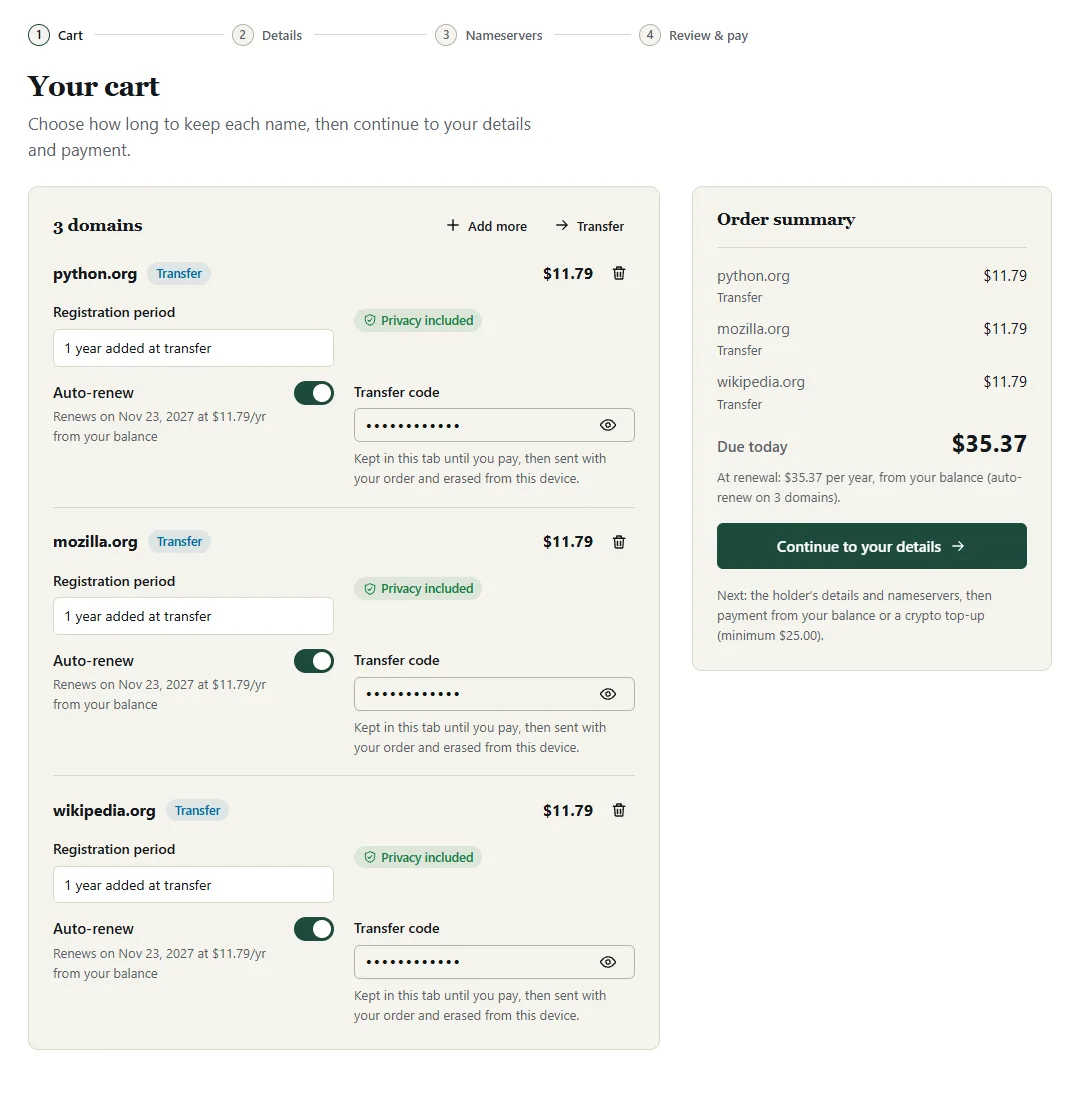
Pay a transfer order, a renewal run of up to 100 domains or a new registration. The cart asks for the registrant email, which ICANN rules require you to confirm within 15 days. In My domains, "Top up and renew" opens the cart whenever credit runs short.
How much should you top up?
At least your order total, in top-ups of $25 to $10,000. Each domain is charged in dollars at its listed price, with no volume tiers, so the total is the count times each extension's price: 40 .com renewals cost $467.60, and 100 cost $1,169.00. Several top-ups add up in one balance.
- One domain. For a name you move or renew, a .com costs $11.69 to transfer in and $11.69 a year to renew; the $8.00 first year applies only to a new registration, which then renews at $11.69. All three sit below the $25 floor, so a $25 top-up for one new .com also covers next year's renewal. Whatever is left waits on the balance for renewals; ask inside 30 days and the unused remainder comes back as USDT or USDC instead.
- A renewal run. Forty .com renewals cost 40 × $11.69 = $467.60. Fund that sum in one go, or across two top-ups in different coins.
- A large portfolio. Past $10,000, split the funding into several top-ups, each credited separately. Orders still cap at 100 lines, so moving 300 .com domains means three orders drawn from one balance, $3,507.00 in all. A name costs the same whether it is your first or your thousandth.
Why is Monero checked by hand?
Because Monero's ledger conceals who paid, who was paid and how much. A person on the desk opens our wallet with its view key, ties each payment to its top-up after 10 blocks and then credits it. No processor stands between your wallet and ours, so an XMR top-up is credited once checked, not the second its block appears.
The view key is a read-only key that reveals incoming transfers but can never move money. Renewing a portfolio in XMR, with the timing to plan for, is covered in Monero domain renewals; stablecoin top-ups, which need no manual check, in USDT domain payments.
What happens to the balance?
It stays in US dollars, never expires and pays transfers, renewals and registrations at each extension's listed price. A .com costs $11.69 to renew or bring in by transfer, and $8.00 for a new registration's first year only; the prices page has every extension. A failed transfer returns its price to the balance; cash-outs are limited to one case.
Credit on a Zonequill account never expires and is spent on transfers, renewals and registrations. When the minimum top-up made you send more than the order itself, write within 30 days of that payment and any part still unspent is returned in USDT or USDC. Other credit remains on the account and is not cashed out, unless the law requires it.
When a transfer fails, or the losing registrar blocks it, its price returns to your balance. Each case is listed in the refund policy.
Questions about paying in crypto
Can I buy a domain with Bitcoin?
Yes. Fund your Zonequill balance with BTC, then use that credit for a new registration, a renewal or an incoming transfer. Bitcoin counts as received after two blocks. The same balance also takes Monero, USDT, USDC, ether, Solana and Litecoin, so a later top-up can use a different coin.
Do I have to give a transaction ID (TXID)?
No. Pressing "I've sent the payment" is enough: the desk finds the transfer on chain by itself. A TXID is the unique reference a blockchain gives each transaction. Keep it in your wallet history; it only helps if you later email the desk about a payment that never showed up.
Is there a minimum or maximum top-up?
Every top-up sits between $25 and $10,000, and there is no limit on how many you make, so a big renewal run can be funded in several payments. If the $25 floor pushed you above the cost of your order, the unused part goes back to you as USDT or USDC on request within 30 days.
Can I withdraw my balance back to crypto?
Only in one case: an unspent overpayment caused by the $25 minimum, claimed within 30 days and paid back in USDT or USDC. Any other credit remains usable with no end date but is not cashed out, unless a law demands it. Blocked transfers refill the balance, not your wallet.
Do you accept credit cards or PayPal?
No. Zonequill takes cryptocurrency only: Monero, Bitcoin, Tron or Ethereum USDT, USDC, ether, Solana and Litecoin. Cards, PayPal and bank wires are not offered, so no card number or bank record is ever part of an order.
Sources
- Monero project, Moneropedia: view key, checked 23 November 2026. Reveals incoming transfers; outgoing ones cannot be reliably seen with it
- Tether, supported protocols, checked 23 November 2026. Lists the Tron and Ethereum versions of USDT